Best Alarm Clock for Podcasters on a Tight Desk

A clock that shares a room with a microphone has a different job than one that just wakes you up. Seven picks compared on footprint, display size, alarm type and power, with the trade-offs each one makes.

By Cody HartUpdated 19 min read
On this page
- Best alarm clock for podcasters at a glance
- What got cut, and why
- Does a clock actually belong near a microphone?
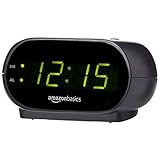
- 1. Amazon Basics Small Digital Oval Alarm Clock with LED — Best overall
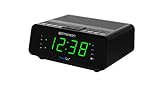
- 2. Emerson SmartSet Dual Alarm Clock Radio with AM/FM — Best upgrade
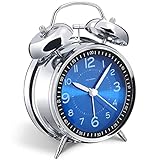
- 3. Peakeep Loud Alarm Clock for Heavy Sleepers Adults — Most versatile
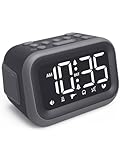
- 4. Peakeep Digital Alarm Clock for Bedroom Bedside — Best lightweight
- 5. Mesqool Digital Projection Alarm Clock with Dual Alarms — Best minimal setup
- 6. Acedeck Super Loud Alarm Clock: 115dB Wake-Up Power — Best for families
- 7. Sonic Alert Sonic Bomb Dual Extra Loud Alarm Clock with — Best premium
- What each price tier buys you here
- Analog bell or digital LED: which suits a recording room?
- What the listings never tell you
- The verdict
- FAQ
The best alarm clock for podcasters is the Amazon Basics Small Digital Oval Alarm Clock, because at 2.4 x 4.5 x 3.5 in and 6.56 oz it takes up less desk than a pop filter and still holds time for 8 hours on battery backup. If you want radio and two independent alarms in the same box, the Emerson SmartSet CKS1900 is the better buy at 4.9 x 6.1 x 1.5 in.
Money buys different things at each tier in this category. The cheapest picks here buy you a lit display, a snooze button and battery backup, and nothing else. The middle buys you a bigger display, brightness control and a USB port. The top of this set buys you volume you can feel: a 113dB claim with a bed shaker, or a 115dB claim with six sound choices. That last tier is the one to think hardest about if your microphone lives in the same room.
Best alarm clock for podcasters at a glance
| Pick | Footprint (in) | Alarm type | Price |
|---|---|---|---|
| 2.4 x 4.5 x 3.5 | Digital buzzer 0.7" LED |
Check Price | |
| 4.9 x 6.1 x 1.5 | Radio or buzzer 0.9" LED |
Check Price | |
Most versatile Peakeep Loud Alarm Clock for Heavy Sleepers Adults |
6.5 x 4 x 1.5 | Twin bell, analog 50-min ring claim |
Check Price |
Best lightweight Peakeep Digital Alarm Clock for Bedroom Bedside |
3.3 x 7 x 1.5 | Digital buzzer 2" digits |
Check Price |
Best minimal setup Mesqool Digital Projection Alarm Clock with Dual Alarms |
3.58 x 1.18 x 1.5 | Beep, 5 volumes 7" projection |
Check Price |
Best for families Acedeck Super Loud Alarm Clock: 115dB Wake-Up Power |
3.15 x 4.8 x 1.5 | 115dB claim 6 sounds |
Check Price |
| 6 x 7 x 7 | 113dB claim Bed shaker |
Check Price |



What got cut, and why
Three things knocked listings out before I ranked anything.
The first was bulk. A clock that measures 6 x 7 x 7 in is a fine nightstand object and a bad desk object, and half the candidates I looked at were in that class or larger. Only the Sonic Bomb survived that cut, and it survived on a different argument. The second was the absence of any published dimension at all. If a listing will not tell me how deep the body is, I cannot tell you whether it clears the base of a boom arm. The third was anything with an unclear power story. A clock that loses the time in a brief outage is worse than no clock when you have a 6am recording block.
What survived is a set with a real spread. Footprints run from 1.18 in deep on the Mesqool to a 7 in cube on the Sonic Bomb. Weights run from 0.53 lb to 1.32 lb. Two are battery-only or analog, five run on AC with backup. Three publish a warranty term, four publish none. That spread is what makes a comparison worth reading, and it's why picking the best alarm clock for podcasters is more about your room than about the clock.
Does a clock actually belong near a microphone?
Here's the honest answer: Amazon's search does not filter for podcasters, and none of these seven listings claim to be built for recording. So nothing below is sold as studio equipment, and I'm not going to pretend otherwise. What I can do is judge the published specifications against what a recording setup actually demands, and let you make the call.
Three properties matter when a clock shares a room with a live microphone.
- Movement type. A quartz sweep movement has no tick. Peakeep says the MHP3122 uses one, and calls it non-ticking. That's the manufacturer's claim, not a measurement, but it's the only claim of its kind in this set.
- Mains hum. Five of these seven run on AC power. An AC adapter near an audio interface is one more thing sharing your outlet strip. Battery operation sidesteps that entirely.
- Physical footprint. Anything you have to shove aside mid-session becomes a bump on the recording. Small wins.
The Peakeep MHP3122 is the only pick that is battery operated and claims a silent movement. It's also the only analog face here. If your bar is "nothing in this room makes noise or draws mains power", that's your shortlist of one. If your bar is looser, the whole set opens up.
1. Amazon Basics Small Digital Oval Alarm Clock with LED — Best overall
The smallest footprint in this set, with battery backup and a nightlight, at the lowest price position of the seven.
Best for: a cramped desk that already holds a mic arm and interface Skip it if: you need a display readable from across a room
Nothing else here is this small. The TT1001 measures 2.4 x 4.5 x 3.5 in and weighs 6.56 oz, which is less footprint than the Peakeep MHP6010's 7 in width and a fraction of the Sonic Bomb's 7 in cube. On a desk that already carries an arm, an interface and a monitor stand, that difference is the whole decision.
The display is a 0.7-inch green LED, the second smallest here after the Emerson's 0.9 inch. Amazon Basics says a built-in nightlight illuminates a dark room, and that batteries retain time and alarms in memory for 8 hours during an outage. Batteries aren't included, which the listing states plainly. It's AC powered with an integrated supply, so there's no separate brick to find room for.
It also carries a published warranty, 6 months from the manufacturer, which is shorter than the Sonic Bomb's year but longer than nothing. This is the pick buyers here choose most often by a wide margin.
The trade-off is reach. A 0.7-inch display read from a bed eight feet away is squinting territory, and the Peakeep MHP6010's 2-inch digits exist precisely for that job. You also get a single alarm where four of these picks offer two.
Pros:
- Smallest footprint of all seven picks
- 6.56 oz, easy to move off a desk
- 8-hour memory retention on battery backup
- Built-in nightlight, no extra lamp needed
- Published 6-month manufacturer warranty
Cons:
- 0.7-inch display is the second smallest here
- Batteries for backup not included
- Single alarm only, unlike four rivals
- No brightness adjustment published
2. Emerson SmartSet Dual Alarm Clock Radio with AM/FM — Best upgrade
The only pick here that sets its own time after a power cut, and the only one with a radio.
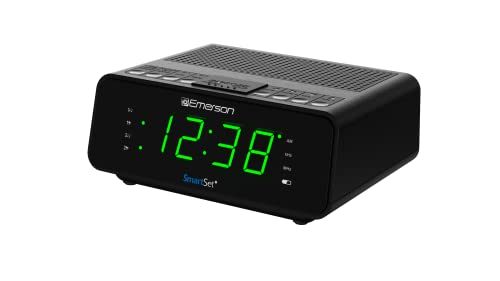
Best for: anyone who wants radio and dual alarms in one box Skip it if: you want nothing that can make sound in the room
The CKS1900 does something no other pick in this set does. Emerson says its patented SmartSet technology sets the year, month, date, day and time as soon as it's plugged in, and again after a power outage. Every other clock here asks you to reset it by hand. If you record at odd hours and your building's power flickers, that's a real convenience.
It measures 4.9 x 6.1 x 1.5 in and weighs 0.95 lb, so it's slim front to back but wide. The 0.9-inch jade green LED display is dimmable, which matters if the clock ends up in a shot. Emerson lists digital PLL AM/FM tuning with 20 memory presets, dual alarms that wake to radio or buzzer, and a programmable sleep-to-music timer. Front-facing controls mean you're not reaching around the back in the dark.
The warranty is 90 days limited, the shortest published term in this set. It's also a radio, which means it's a speaker sitting in your room. Some people will see a second monitoring source. Others will see one more thing to unplug before rolling.
Pros:
- Auto-sets time after outages, unique here
- Dimmable 0.9-inch display for night use
- Dual alarms with radio or buzzer choice
- 20 AM/FM presets and sleep timer
- Only 1.5 in deep
Cons:
- 90-day warranty, shortest published here
- 6.1 in wide, second widest footprint
- Built-in speaker sits in your recording space
- Display smaller than three other picks
3. Peakeep Loud Alarm Clock for Heavy Sleepers Adults — Most versatile
The only battery-operated pick, and the only one claiming a non-ticking movement.
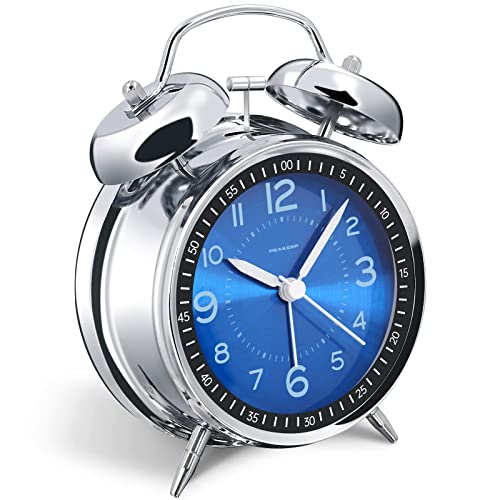
Best for: an unplugged shelf away from the recording position Skip it if: you need a lit display all night
This is the outlier and the most interesting pick in the set. The MHP3122 is analog, metal, 4.5 in wide by 6.5 in high, and it runs on a battery. No adapter, no outlet, no cable routed across a desk. Peakeep says the quartz sweep movement produces no tick-tock noise, and that the casing and reading face are both metal apart from the back board.
The alarm is a twin bell with a hammer between, and Peakeep claims it rings for 50 minutes until you shut it off. There's a light button on the back rather than a permanent glow, which the listing frames as keeping the night environment dark. At 0.57 lb it's the second lightest here.
Being unplugged is the argument. Nothing about it competes for space on your power strip, and you can put it on a shelf across the room where no cable needs to reach. That flexibility is why it earns "most versatile" in a set where five picks are tied to a wall socket.
Now the losses. A mechanical bell hammer is a moving part inches from a hammer plate, and no manufacturer claim about the movement covers the ring itself. There's no display to glance at, no dual alarm, no published warranty and no snooze mentioned in the listing.
Pros:
- Battery operated, no adapter or outlet needed
- Non-ticking quartz movement per Peakeep
- Metal case and face, 0.57 lb
- Light-on-demand button, no constant glow
- Second cheapest pick here
Cons:
- No published warranty term
- No lit display for a quick night glance
- Single alarm, no dual schedule
- Mechanical bell has moving parts near a mic
4. Peakeep Digital Alarm Clock for Bedroom Bedside — Best lightweight
The biggest digits in the set at 2 inches, and the lightest AC-powered pick at 6.4 oz.

Best for: reading the time from a bed across the room Skip it if: your desk depth is measured in single digits
If legibility is the thing you keep losing on, the MHP6010 solves it. Peakeep lists 2-inch digits, taller than the Emerson's 0.9 inch and nearly three times the Amazon Basics figure. At 6.4 oz it's the lightest clock in this set, lighter even than the battery-operated Peakeep.
The listing claims 5 brightness settings and 5 alarm volume settings, so the same unit can run dim at night and loud in the morning. That range is more granular than anything else here except the Mesqool. There's a USB charger port, an AC/DC adapter included, and battery backup for timekeeping.
Two sellers list it, which is one more than four of the other picks. That's a small point, but it's worth noting where most of this set has a single source.
The catch is shape. It's 7 in wide, tied with the Sonic Bomb for the widest body here, though only 1.5 in deep. On a nightstand that's fine. On a desk where the Amazon Basics needs 4.5 in, you're giving up half a foot of surface for bigger numbers. There's also no published warranty, and unlike the Emerson it won't reset itself after a cut.
Pros:
- 2-inch digits, largest direct display here
- Lightest pick in this set at 6.4 oz
- 5 brightness and 5 volume levels
- USB charging port and adapter included
- Only 1.5 in deep
Cons:
- 7 in wide, ties for widest here
- No published warranty term
- Manual time reset after an outage
- Blue LED only, no colour choice listed
5. Mesqool Digital Projection Alarm Clock with Dual Alarms — Best minimal setup
Puts a 7-inch time display on your ceiling from a body only 1.18 in deep.

Best for: keeping the desk surface completely clear Skip it if: your ceiling is textured, dark or far away
The clever move here is moving the display off the furniture. Mesqool says a 180-degree rotatable swivel projector throws the time onto a wall or ceiling, with an optimum projection distance the listing gives as starting at 1.6. The unit itself measures 3.58 x 1.18 x 1.5 in and weighs 0.53 lb, making it the lightest and shallowest body in this set.
Mesqool also lists a 7-inch on-unit display with a 5-level dimmer, a separate 5-level dimmer for the projection, dual alarms with a big snooze button, and a beep alarm with 5 volume levels and gradual ramp-up. The warranty is a year, plus a 30-day money-back window and a stated 24-hour support response.
That's the most published adjustment of any pick here: brightness on two separate outputs, plus volume. For a room where lighting matters, that control is worth something.
Projection has conditions attached, though. It needs a surface that's reasonably light, flat and within range, and a dark room to read well. Textured ceilings scatter it. The published dimensions are also strange for something claiming a 7-inch display, so treat the display figure as the manufacturer's number rather than a body measurement. And it's the second most expensive pick here.
Pros:
- Only 1.18 in deep, shallowest body here
- 0.53 lb, lightest pick in the set
- Separate 5-level dimmers for screen and projection
- Dual alarms with gradual volume ramp
- One-year warranty plus 30-day money back
Cons:
- Projection needs a light, flat, close surface
- Second most expensive pick here
- Published dimensions sit oddly with the 7-inch display claim
- Beep alarm only, no radio or sound choices
6. Acedeck Super Loud Alarm Clock: 115dB Wake-Up Power — Best for families
The highest volume figure claimed in this set, with six selectable alarm sounds.

Best for: a household where two schedules share one clock Skip it if: you record in the same room you sleep in
Acedeck puts a number on the box and builds everything around it. The listing claims a 115dB alarm, the highest figure in this set, ahead of the Sonic Bomb's 113dB claim. Both are manufacturer claims and neither is a measurement I can verify, but 115dB is what the L01 advertises.
Beyond volume, this is a well-specified clock. Acedeck lists six alarm sounds, two independent alarms, a snooze function, a 4.2-inch LED screen with adjustable brightness, a USB charging port, and an alarm memory system with AAA battery backup that holds settings through an outage. The body is 3.15 x 4.8 x 1.5 in at 0.75 lb, which is compact for what it packs. Six sounds is the widest choice here.
Where it stumbles is elsewhere. It's the most expensive pick in this set alongside the Sonic Bomb, and it publishes no warranty term, while the cheapest clock here publishes 6 months and the Mesqool publishes a year. It's also the slowest-moving of the seven by some distance, so fewer buyers here have chosen it than any other pick. A 115dB alarm is a lot of energy released into a room full of soft-surface treatment you paid for, and only one seller lists it.
Pros:
- 115dB claim, highest figure in this set
- Six selectable alarm sounds
- Dual alarms with AAA backup memory
- 4.2-inch display with brightness control
- USB charging port on a 0.75 lb body
Cons:
- No published warranty term at all
- Ties for most expensive pick here
- Slowest seller of the seven
- Only one seller lists it
7. Sonic Alert Sonic Bomb Dual Extra Loud Alarm Clock with — Best premium
The only pick with a bed shaker, and the longest published warranty in the set.

Best for: editors who sleep through everything after a late session Skip it if: your nightstand is small or shared
The Sonic Bomb takes a different route to the same problem. Alongside a claimed 113dB alarm, Sonic Alert includes a vibrating shaker unit that goes under the mattress or pillow. Nothing else in this set wakes you physically. If you've slept through a buzzer before an early call, that's the specification that matters.
It's also the most configurable alarm here. Sonic Alert says the duration adjusts from 1 to 59 minutes and the snooze from 1 to 30 minutes, and the volume is adjustable. The warranty is 1 year parts and 1 year labor, the strongest published cover of the seven. This is the oldest design in the set, released in 2007, which tells you the SBB500SS has stayed on the market a long time.
The cost is space, and a lot of it. Listed dimensions are 6 x 7 x 7 in with the unit itself given as 5.5 in wide, 5.5 in high and 3 in deep, and it weighs 1.32 lb. That's the heaviest and by far the bulkiest thing here, more than double the Amazon Basics weight. There's a shaker cable to run under bedding too. On a nightstand shared with a lamp, a glass and a phone, that's a real squeeze. It also ties for the highest price position with no display-size figure published.
Pros:
- Only pick with a vibrating bed shaker
- 1 year parts and labor, longest cover here
- Alarm duration adjustable 1 to 59 minutes
- Snooze adjustable 1 to 30 minutes
- On the market since 2007
Cons:
- 6 x 7 x 7 in, bulkiest pick in the set
- Heaviest at 1.32 lb
- Shaker cable to route under bedding
- No display size published, unlike five rivals
What each price tier buys you here
The seven picks split cleanly into three groups, and the jump between them buys specific things.
- The entry group. Amazon Basics, the Peakeep MHP3122 and the Emerson sit here. You get a working alarm, battery or memory backup, and one genuinely distinctive feature each: the smallest body, battery-only operation, or auto time setting. Two of the three publish a warranty.
- The middle. Only the Peakeep MHP6010 occupies this tier. The money goes to display size, 2-inch digits, plus five-step brightness and volume control and a USB port. No warranty is published.
- The top. Mesqool, Acedeck and Sonic Alert. Here you're buying either a projected display or serious wake-up force. The Mesqool and Sonic Bomb publish warranties; the Acedeck does not.
Read down that list and one thing stands out. Spending more in this set does not reliably buy you better cover. The cheapest pick publishes 6 months, the Mesqool publishes a year, and the Acedeck at the top publishes nothing. If a warranty matters to you, check it per product rather than assuming the tier decides it. That's a fair summary of how to shop for the best alarm clock for podcasters: the deciding features do not line up neatly with the price ladder.
Analog bell or digital LED: which suits a recording room?
Six of these clocks are digital. One is analog. The split matters more than it looks.
Digital gives you a lit display, dual alarms on four picks, brightness control on three, and mains power with battery memory. That last part is the strength: the Amazon Basics holds alarms for 8 hours without power, the Acedeck holds settings on AAA backup, and the Emerson resets itself entirely. If you work irregular hours and can't afford a missed alarm, digital is the safer class.
Analog, here, means the Peakeep MHP3122. Its advantages are narrow and real: no cable, no adapter, no glow unless you press the light button, and a claimed non-ticking quartz movement. Metal case, 0.57 lb, and it can live anywhere in the room because nothing has to reach it.
- Choose digital if you need a readable time at 3am and two alarms.
- Choose analog if you want zero cables in the recording space.
- Choose digital with dimmers (MHP6010 or Mesqool) if the clock might end up on camera.
- Choose the Sonic Bomb or Acedeck only if the clock lives in a separate room from your microphone.
That last line is the one I'd underline. A 113dB or 115dB claim is a household solution, not a studio one.
What the listings never tell you
Four gaps in this data are worth knowing before you buy.
Actual measured loudness. The 115dB and 113dB figures are manufacturer claims on the box, and neither listing says how or where they were measured. Treat them as relative signals: the Acedeck claims more than the Sonic Bomb, and both claim far more than anything else here. That's all you can safely conclude.
Display size on two picks. The Sonic Bomb publishes no display dimension, and the Peakeep MHP3122 is analog so the question doesn't apply. If legibility from distance is your priority, the picks that publish a figure are the ones you can actually compare: 0.7 inch, 0.9 inch, 2 inch, 4.2 inch and a 7-inch projection claim.
Colour options. Each listing here names one colour: black, gray with white digits, black and red, blue, jewel blue, blue digits with blue projection. If a specific look matters for a shot, you're choosing from what's listed, not from a palette.
How many sellers stock it. Four of these seven are listed by a single seller. The two Peakeep clocks and the Mesqool each have two. That's a thin supply picture across the board, so if a specific model is what you want, don't assume alternatives exist alongside it.
The verdict
The Amazon Basics TT1001 is the best alarm clock for podcasters for most people, and the reason is boring and decisive: 2.4 x 4.5 x 3.5 in and 6.56 oz. It's the smallest body in this set by a clear margin, it holds alarms for 8 hours without power, it has a nightlight instead of a lamp, it publishes a 6-month warranty, and it's the cheapest of the seven. Buyers here pick it more often than anything else, and the specifications explain why.
Two conditions flip that. First, if you cannot read a 0.7-inch display from where you sleep, buy the Peakeep MHP6010 instead. Its 2-inch digits are nearly three times the height, plus five brightness levels and five volume levels, and it weighs less at 6.4 oz. You pay for that in width, 7 in against 4.5 in.
Second, if you want nothing mains-powered in the recording space, the Peakeep MHP3122 is the only pick that qualifies. It's battery operated, metal, 0.57 lb, and Peakeep claims a non-ticking quartz movement. No cable, no adapter, no permanent glow.
The Emerson CKS1900's exact advantage over the winner is self-setting time. It resets year, month, date and time on its own after a power cut, and no other clock here does that.
FAQ
Which alarm clock for podcasters gives the most for the least money?
The alarm clock for podcasters that gives most for least is the Amazon Basics TT1001. It's the cheapest of these seven and still delivers the smallest footprint at 2.4 x 4.5 x 3.5 in, a nightlight, snooze, 8-hour battery memory, and a published 6-month warranty. Nothing else in this set combines a warranty with the lowest price position.
Is a loud 115dB alarm clock worth it for someone who records at home?
A loud 115dB alarm clock is worth it only if the clock lives away from your microphone. The Acedeck L01 claims 115dB and the Sonic Bomb claims 113dB, both manufacturer figures. Those are household wake-up tools for genuinely heavy sleepers. In a treated recording room you'd rather have the Amazon Basics footprint or the Peakeep's silent quartz movement.
What display size do I need to read the time from across a room?
The display size you need climbs fast with distance. The Peakeep MHP6010 lists 2-inch digits, the Acedeck a 4.2-inch screen, and the Mesqool a 7-inch projection. Against those, the Amazon Basics 0.7-inch LED and the Emerson 0.9-inch display are close-range readouts. Measure the gap from your pillow to the clock before choosing.
Amazon Basics TT1001 or Emerson CKS1900: which should I pick?
Choose the Amazon Basics TT1001 for space. It's 4.5 in wide against the Emerson's 6.1 in, weighs 6.56 oz against 0.95 lb, and carries a 6-month warranty against Emerson's 90 days. Choose the Emerson CKS1900 for convenience: it auto-sets time after outages, offers dual alarms, AM/FM with 20 presets and a dimmable display.
What mistake do people make buying a clock for a studio space?
The mistake people make is buying for loudness first. Volume solves oversleeping, not the problems a recording space creates. Footprint, cable count, brightness control and movement noise decide whether a clock is livable next to a microphone. The Sonic Bomb is 6 x 7 x 7 in and 1.32 lb, which is a lot of desk for a feature you may not need.
Start with a tape measure, not a specification sheet. Measure the clear space beside your interface and the distance from your pillow to that spot. If the space is tight and the distance short, the Amazon Basics TT1001 is the right default: it asks for less room than anything else here, retains your alarm through an outage, and publishes a warranty the pricier picks in this set don't match. If the distance is long, jump to the Peakeep MHP6010 for its 2-inch digits. If you want nothing plugged in at all, the metal Peakeep MHP3122 is the only one that fits that brief.