Best Solid Wood Closet System for Tall People

Tall coats need tall towers. Five closet systems compared by frame height, rod count and hanging span, with the Besiost 80-inch set leading the field.

By Cody HartUpdated 15 min read
On this page
- How I screened the field down to five
- Best solid wood closet system for tall people at a glance
- Does an 80-inch frame really help tall wardrobes?
- 1. Besiost Closet Systems with 6 Wood Drawers — Best overall
- 2. secilix Closet System with 6 Wood Drawers — Best for beginners
- 3. Aheaplus Closet System — Best budget pick
- 4. Unikito 12FT Modular Closet System with 8 Hanging Rods — Best premium
- 5. Aheaplus Closet System with 4 Drawers — Best for heavy use
- Frame height versus rod height: what actually decides drop
- How wide can you go before a wall closet becomes a warehouse?
- What the listings do not tell you about tall garments
- Assembly, walls and the mounting question
- The verdict
- FAQ
The best solid wood closet system for tall people is the Besiost Closet Systems with 6 Wood Drawers, a paired 80 x 42.6 x 15 in build that lifts the top rail high enough to hang full-length coats without pooling. If you have a very wide wall and want one continuous run, the secilix Closet System with 6 Wood Drawers is the better buy, spanning 6.4 to 12.3 ft with cuttable shelves and six expandable rods.
How I screened the field down to five
Data-first, because a search for a tall-friendly closet returns a lot of listings that never publish a height figure. I pulled every mounted closet system and freestanding wood tower in this category, kept only the ones with usable dimension data, and threw the rest out.
Three cuts did the work:
- No height dimension published. If the listing did not state the vertical figure in inches, it went. A tall wardrobe cannot hang on marketing copy.
- Wire and fabric builds. The keyword calls for wood. Every pick here uses MDF or wood-panel construction with wood drawer fronts.
- Single narrow towers with one rod. Fine for a hallway, wrong for anyone whose coats measure 60 inches shoulder to hem.
That left five: two Aheaplus builds at the entry positions, the mid-priced Besiost pair, the secilix expandable, and the Unikito 12-foot modular at the top. Every one of them publishes an 80-inch or taller frame figure, and every one of them lists at least four hanging rods across its widths.
A note on the keyword. "Tall people" is what the shopper types, but the shopper usually means two different things at once: a tall body needing a high rod, and a tall wardrobe of coats and dresses needing a high rail with drop underneath. This category serves the second better than the first. None of these listings publishes an adjustable-rod height figure, so I have judged them on frame height and rod count, which is what the data actually supports.
Best solid wood closet system for tall people at a glance
| Pick | Frame height | Rods / drawers | Price |
|---|---|---|---|
Best overall Besiost Closet Systems with 6 Wood Drawers |
80 in | 2 rods 6 drawers |
Check Price |
Best for beginners secilix Closet System with 6 Wood Drawers |
81 in | 6 rods 6 drawers |
Check Price |
Best budget pick Aheaplus Closet System |
80 in | 4 rods 4 drawers |
Check Price |
Best premium Unikito 12FT Modular Closet System |
80 in | 8 rods 4-piece tower set |
Check Price |
Best for heavy use Aheaplus Closet System with 4 Drawers |
Not listed (8 ft wide claim) |
4 rods 4 drawers |
Check Price |


Does an 80-inch frame really help tall wardrobes?
Yes, but read the number carefully. An 80-inch tower gives you the tallest possible top rail this category publishes, and a top rail near the 80-inch mark is what lets a 60-inch coat hang clean with room for a hanger hook above it. Below 78 inches, long garments start to drag on the base shelf or on whatever sits underneath.
Three things to check before ordering:
- Ceiling minus skirting minus baseboard. An 80-inch frame needs slightly more clearance than 80 inches. Measure from the finished floor to the lowest obstruction above.
- Where the top shelf sits inside the frame. The listings quote the frame height, not the rod height. Rod position is set by where you install the shelf that carries it.
- Drop below the rod. A tall person's coat needs the same drop as anyone else's coat; what changes is the total floor-to-hook height, which is what these 80-inch frames deliver.
If your ceiling clears 82 inches, all five picks fit. Below that, the two Aheaplus builds and the Besiost pair still work if you shim the base carefully; the Unikito and secilix, being wider, are less forgiving of an out-of-level floor.
1. Besiost Closet Systems with 6 Wood Drawers — Best overall
Two 80-inch towers, six wood drawers between them, and a 42.6-inch shared span that hangs long coats without pooling.
Best for: a tall wardrobe of long coats and dresses in a standard-height bedroom Skip it if: your ceiling clears less than 82 inches after skirting and baseboard
The Besiost pair is the pick because the geometry works for tall garments in a way the wider systems do not. At 80 x 42.6 x 15 in per unit, you get the maximum published frame height in this set alongside a hanging bay wide enough for coats and dresses to sit shoulder to shoulder without crushing. Six wood drawers cover folded storage across the two towers, and two top shelves take the seasonal boxes.
Besiost says the build uses high-quality MDF with a weight capacity above 1000 lb, and that the two towers can stand together as one long unit or split into two separate small closets. That flexibility matters if you move, or if your bedroom is L-shaped and you want to split the run around a corner.
The trade-off against the wider picks is span. You get 42.6 inches of hanging per tower, not the 12-foot run the Unikito offers. If your wardrobe is bigger than the drawers and rods hold, you outgrow this before you outgrow a modular system. Against the secilix, you lose expandability; against the two Aheaplus builds, you gain a second tower and two extra drawers.
Pros:
- 80-inch published frame height
- Six wood drawers across the pair
- Splits into two independent closets
- 15-inch depth suits shallow walls
- Mid price position for two towers
Cons:
- Only two hanging rods total
- Fixed 42.6-inch span per tower
- No published adjustable-rod detail
2. secilix Closet System with 6 Wood Drawers — Best for beginners
A cuttable, 6.4 to 12.3 ft expandable frame with six rods and six drawers, forgiving of imperfect walls.
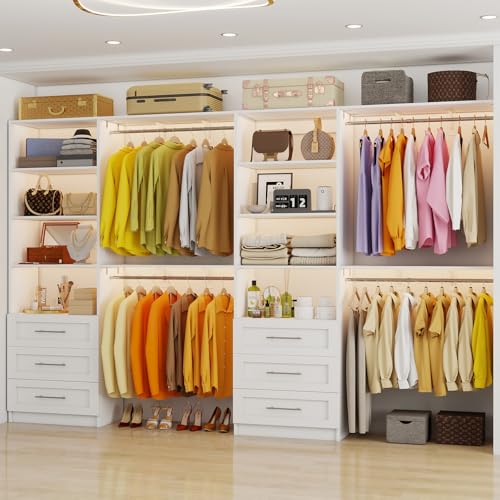
Best for: a first-time closet build across a very wide wall Skip it if: you want a compact single-tower setup
The secilix system suits a first build because the shelves cut to fit, so the wall's real dimensions rule rather than the box's. Frame height is 81 inches, a hair taller than the Besiost, and the published span runs from 6.4 ft to 12.3 ft. Six expandable rods spread across that span give you separate bays for coats, shirts, trousers and dresses, which is the layout a beginner benefits from most.
secilix says each individual unit supports about 1000 lb and calls out sturdy wood drawers in place of fabric bins. In practice for a beginner, the cut-to-fit shelves are the real story: a wall that measures 9 ft 4 in becomes a workable dimension rather than a rounding problem.
Against the Besiost pair, you gain rods and span, and you lose the modular split. Against the Unikito, you lose three feet of maximum width and two rods, but you also lose the premium price position. It is the second-most expensive here, and it is the pick I would give someone who has never built a closet before.
Pros:
- 81-inch published frame height
- Six expandable hanging rods
- Cuttable shelves for odd widths
- Six wood drawers included
- Spans 6.4 to 12.3 ft
Cons:
- Second most expensive in this set
- Only one seller lists it
- Wide layout wastes a small wall
3. Aheaplus Closet System — Best budget pick
The cheapest of the five, an 80 x 74 x 15.7 in single-tower build in white oak with four rods and four drawers.
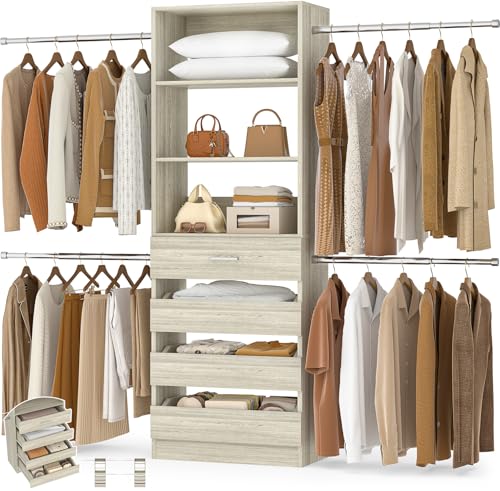
Best for: a single tall bay on a tight outlay Skip it if: you need six drawers or a set of two towers
The white-oak Aheaplus is the entry price position, and it earns the slot by still clearing the 80-inch mark that matters for tall garments. Dimensions are 80 x 74 x 15.7 in, so you get a 74-inch wide run with a shallow 15.7-inch depth, four hanging rods across the span and four wood drawers in a central tower. The white-oak finish is the only warm-wood option in the set; every other pick is white.
Aheaplus describes it as a wood closet organizer system with tower, walk-in wardrobe layout with four hanging rods. That is enough for coats on one side, shirts on the other and a folded stack down the middle. It is a real closet, not a garment rack in disguise.
The compromise is drawer count and top storage. Two fewer drawers than the Besiost, no expandable rod count, and a single-tower layout that cannot split into two rooms. Against the black-oak Aheaplus, you gain published dimensions, which is the more useful trade for a tall-wardrobe buyer. Two sellers list it, so stock is a little steadier than the single-seller picks.
Pros:
- Cheapest of the five
- 80-inch frame height
- White oak finish, only warm option
- 74-inch published width
- Two sellers stock it
Cons:
- Only four drawers
- No adjustable-rod detail
- Single tower cannot split
4. Unikito 12FT Modular Closet System with 8 Hanging Rods — Best premium
A four-piece 12-foot modular set with 8 rods and a claimed 2800 lb load, sized for a dressing room.

Best for: a dedicated dressing room with a 12-foot run of wall Skip it if: you have a narrow reach-in or a low ceiling
The Unikito is the most expensive pick here and the widest by a clear margin. Four pieces line up across 144 inches of wall, eight rods split the wardrobe into bays for coats, jackets, shirts and trousers, and the frame stands 80 inches tall at a 16-inch depth. Unikito says the build uses premium thickened MDF with a load rating above 2800 lb across the full system.
For a tall wardrobe of long coats and dresses, the value of the Unikito is not raw rod count. It is the ability to keep long garments separate from short ones, so nothing pools on the shelf below and nothing brushes a folded stack. Eight rods let you dedicate two bays to full-length hanging while the rest carry shirts and trousers at standard drop.
The costs are real. It is the slowest seller of the five by category rank, it demands a wall the size of a small hallway, and its 16-inch depth is deeper than the four other picks, so it eats floor space a bedroom may not spare. Buy it for the room that is meant to be a closet, not for the bedroom that also holds a bed.
Pros:
- 144-inch published width
- Eight hanging rods
- 80-inch frame height
- Modular expansion between towers
- Claimed 2800 lb load rating
Cons:
- Most expensive pick here
- Deepest at 16 inches
- Slowest seller in this set
5. Aheaplus Closet System with 4 Drawers — Best for heavy use
An 8-foot wide black-oak build with four rods and four drawers, priced second-cheapest here.

Best for: someone who wants a darker finish and heavy rod loading in an 8-foot span Skip it if: you need published height and depth figures before ordering
The black-oak Aheaplus shares its model family with the white-oak budget pick but publishes far fewer dimensions on its listing. What the title states is an 8 ft wide closet organizer with four wooden drawers, tower and four hanging rods in a black finish. What the specification block does not publish is the frame height or the depth. That gap is why it sits fifth here rather than higher.
For heavy use the layout still holds up. Four rods across 8 ft mean each bay is roughly 24 inches wide, which is enough to load densely without hangers fighting each other. The dark oak hides scuffs better than white in a room that gets daily traffic, and the tower gives four drawers for folded stacks that would otherwise creep onto shelves.
Against the white-oak Aheaplus, you gain the darker finish and lose the published dimensions. Against the Besiost pair, you lose two drawers and the split-tower option, and you gain a wider single run. Two sellers list it. Buy it if you already own the same product line in white oak and want a matching second closet, or if the finish is what sells it.
Pros:
- Second-cheapest of the five
- Four hanging rods across 8 ft
- Dark oak hides daily wear
- Four wood drawers included
- Two sellers stock it
Cons:
- No published frame height
- No published depth figure
- Sparser specification data than siblings
Frame height versus rod height: what actually decides drop
Most guides on this topic compare rod count. That is not what decides it for a tall wardrobe. Frame height is.
A rod hung inside an 80-inch frame sits roughly six to eight inches below the ceiling of the frame, depending on the shelf that carries it. That puts the rod near the 72 to 74-inch mark, which gives roughly 68 to 70 inches of clear drop above the base shelf. A 60-inch coat clears with room to spare; a 65-inch evening dress just clears. Below a 78-inch frame, that drop drops with it, and full-length garments start to pool.
Rod count matters second. Eight rods across the Unikito give you the option to keep long coats in one bay so they never fight short shirts. Two rods across the Besiost pair force you to segregate by tower instead. Both work; the eight-rod layout is friendlier if half your wardrobe is long.
The trap is buying on width and assuming height follows. The black-oak Aheaplus is the clearest example in this set: its listing states an 8 ft width but no frame height figure. That is a data gap the best solid wood closet system for tall people cannot afford.
How wide can you go before a wall closet becomes a warehouse?
Width in this category sits between roughly 3.5 ft and 12 ft. Where you land on that scale should follow your wardrobe size and your wall, not the other way around.
- Under 6 ft. A single tower with four drawers and one or two rods. The white-oak Aheaplus at 74 in works here.
- 6 to 9 ft. The Besiost pair at 42.6 in per tower fits across roughly 7.1 ft of wall, and the black-oak Aheaplus covers 8 ft in one continuous run.
- 9 to 12 ft. The secilix cuts to fit anywhere in this range with six rods and six drawers.
- 12 ft and over. Only the Unikito publishes this reach, with 144 in of continuous frame and eight rods.
The mistake is buying wider than the wardrobe. Empty rod space collects clutter faster than any other kind of shelf, and a 12-foot run half-full looks worse than a 7-foot run packed neatly. Measure your hangers first.
What the listings do not tell you about tall garments
Four things the specifications leave out, worth knowing before you order the best solid wood closet system for tall people.
- Rod height is not frame height. The listings state one and imply the other.
- The lowest garment sets the base shelf height. If a coat brushes the shelf, raise it, and lose drawer height above the toe.
- Hanger type changes clearance. Chunky wood hangers add roughly an inch to the top of every garment against thin velvet or wire.
- Assembly squareness affects rod sag over time. A closet built out of square carries load unevenly; the rod bows first, the shelf second.
None of the five listings publish an adjustable-rod height range, which is the single most useful specification a tall-wardrobe shopper could see. Ask the seller before ordering if adjustability matters to you, and assume fixed positions until told otherwise.
Assembly, walls and the mounting question
Two of the five are described as mounted systems in their category path: the Besiost pair and the secilix. The Unikito is described by its brand as freestanding and modular. The two Aheaplus builds sit as a mounted system and a garment rack respectively. Read the category before you buy, because a mounted system needs studs behind the drywall and a freestanding one does not.
For a rental, freestanding wins by default. The Unikito and the white-oak Aheaplus are the safer picks where the wall cannot take screws. For an owned home, mounting adds rigidity, and rigidity is what stops rods sagging under a heavy coat load a year later. If you own the wall, mount it; if you rent, do not.
The verdict
The best solid wood closet system for tall people is the Besiost Closet Systems with 6 Wood Drawers, because an 80-inch frame paired with a 42.6-inch hanging bay is the geometry that lets full-length coats and dresses hang clean without brushing the shelf below. Six wood drawers across two towers cover folded storage, and the split-tower option means the same purchase adapts to a bedroom, an L-shape or a move.
The cutoff is width. Under about 8 ft of wall, the Besiost pair or the white-oak Aheaplus is right. Between 8 and 12 ft, the secilix Closet System is the better buy: 81 inches tall, six expandable rods, cuttable shelves. Above 12 ft, only the Unikito publishes the reach, with eight rods across 144 inches of frame.
If price is the constraint, the white-oak Aheaplus is the cheapest 80-inch build in the set and still clears the frame height that decides drop. If finish is the constraint and you want dark oak, the second Aheaplus does the job but expects you to accept a listing that does not publish its frame height.
FAQ
What frame height should I look for in a closet system for tall people?
Frame height around 80 inches is the mark to hit. That puts the rod near 72 to 74 inches once the top shelf sits, which gives roughly 68 to 70 inches of clear drop for a coat or dress. Four of the five picks here publish an 80 or 81-inch frame; the black-oak Aheaplus does not publish its height at all.
Is a solid wood closet system worth it over a wire kit?
A solid wood closet system is worth it if you carry heavy coats, dense shirt collections or long dresses. Wire kits sag under sustained load and squeak on the rail. The wood picks here quote MDF frames with published load figures from 1000 lb per unit up to a claimed 2800 lb across the Unikito. Wire wins on price; wood wins on rod stability over years.
Does the Besiost pair fit under a standard 8-foot ceiling?
The Besiost pair fits under a standard 8-foot ceiling with room to spare. An 8-foot ceiling clears 96 inches, and the Besiost frame stands 80 inches, leaving 16 inches for baseboard, skirting, cornice and clearance to slide the tower into place. Measure your finished floor to the lowest obstruction; if that figure is 82 inches or more, you are safe.
Besiost versus secilix: which wins for a tall wardrobe?
Besiost versus secilix comes down to wall width. Besiost wins for walls under about 8 ft, because two independent 80-inch towers give you a split-and-move option and six drawers between them. secilix wins for walls of 8 to 12 ft, because the cuttable shelves and six expandable rods cover odd widths without leaving empty span. Both stand tall enough for full-length garments.
Do closet systems need to be mounted to the wall?
Closet systems need to be mounted only if the listing says so. The Besiost pair and the secilix sit in a mounted category, so studs behind the drywall matter. The Unikito is described as freestanding and modular. The two Aheaplus builds vary. Renters should default to freestanding to protect the deposit; owners should mount for rigidity, because a mounted rod sags less across a decade of use.
The next step is a tape measure and thirty minutes. Measure the wall you plan to use, floor to lowest obstruction and stud to stud, then measure the longest coat in your wardrobe hanger tip to hem. Those three numbers pick the tower for you. The Besiost pair remains the default because 80 inches of frame with a 42.6-inch hanging bay is the shape a tall-garment wardrobe actually wants; every other pick here trades that shape for width, price or finish. Buy for the wardrobe you own, not the dressing room you imagine.