Best Portable Digital Alarm Clock for Nightstand Use

Five cordless clocks compared on weight, footprint and display, with a clear winner for nightstand use and honest trade-offs for travel.

By Cody HartUpdated 14 min read
On this page
- Best portable digital alarm clock at a glance
- How I cut the shortlist to five
- What actually decides a nightstand clock?
- 1. Sharp SPC483CAMZ — Best overall
- 2. Acedeck T01 — Best upgrade
- 3. Srubambi T02-1 — Best premium
- 4. Peakeep MHP6020 — Best minimal setup
- 5. Peakeep MH-9060 — Best for pros
- Is a portable clock really travel-ready?
- Features worth paying for, and features that waste money
- Quick if/then guide for the indecisive
- The verdict
- FAQ
The best portable digital alarm clock for most nightstands is the Sharp SPC483CAMZ, a 3.21 oz cordless unit measuring 4 x 2.3 x 1.5 in with a rubberised case and an on-demand blue backlight. If you want always-on 1.8-inch digits with auto dimming instead of a button-triggered light, the Acedeck T01 is the better buy. Every pick here runs on batteries alone, so the outlet map of your bedroom stops mattering.
Best portable digital alarm clock at a glance
| Pick | Weight | Display | Price |
|---|---|---|---|
Best overall Sharp SPC483CAMZ |
3.21 oz | Backlight on button press | Check Price |
Best upgrade Acedeck T01 |
4.8 oz | 1.8-in red LED, auto dim | Check Price |
Best premium Srubambi T02-1 |
4.32 oz | Always-on white LED | Check Price |
Best minimal setup Peakeep MHP6020 |
3.68 oz | Green LED, 4 manual dimmers | Check Price |
Best for pros Peakeep MH-9060 |
6.56 oz | LED with night light and temp | Check Price |


How I cut the shortlist to five
I started with the "portable" idea and stripped out anything that fails it. Three cuts did most of the work.
- No mains-only clocks. A clock that dies when unplugged is a bedside ornament, not a portable one. Every pick here runs cordless on AA or AAA cells, and one adds an optional Type-C input.
- No projection or radio clocks. Those add weight, features you probably won't use, and a second reason to fail.
- No units over 7 oz. Portable means you can toss it in a carry-on without noticing, and the heaviest pick here is the Peakeep MH-9060 at 6.56 oz.
What survived is five cordless clocks between 3.21 oz and 6.56 oz, with footprints from 4 x 2.3 x 1.5 in up to 3.94 x 3.94 x 1.5 in. Every one is listed as a Small size in its Clocks > Alarm Clocks category. The differences that matter show up in the display, not the case.
A short note on the keyword. "Portable" here is a shopper's word, not a strict manufacturer category. Amazon's search returned battery-operated bedside clocks alongside travel clocks, and I've treated them the same way: a clock counts as portable if it runs without a cord and fits on a hotel nightstand. Judge the size against your own bag.
What actually decides a nightstand clock?
Most guides compare alarm loudness. That is not what decides it. The display decides it, because you look at the clock a hundred times before the alarm ever fires once.
Three display questions separate these five:
- Always-on or button-triggered? The Sharp lights up when you press snooze. The Acedeck, Srubambi and both Peakeeps show the time continuously.
- Auto dimming? The Acedeck and Srubambi list auto-dimming circuits. The Peakeep MHP6020 offers four manual dimmers plus an auto dimmer. The Sharp and the MH-9060 do not describe auto dimming.
- Digit size? Only Acedeck publishes a figure: 1.8-inch red LEDs. The rest describe their displays as "clear" or "large" without a number.
Alarm behaviour splits into two camps. The Sharp and the MH-9060 use ascending or progressive beeps with snooze. Peakeep's MHP6020 lists five volume levels and a lock function. That's a meaningful gap if you sleep through quiet alarms.
Battery type is the last decider. AA cells run longer than AAA cells at the same drain, so the Acedeck's 4 AA setup is friendlier than the MH-9060's 3 AAA arrangement over a year of use. None of the picks include batteries in the box.
1. Sharp SPC483CAMZ — Best overall
The Sharp wins because it is the lightest, most compact clock here and it does the basic job without asking you to learn a menu.
Best for: a nightstand where the outlet is across the room Skip it if: you want a large red LED you can read without pressing a button
At 3.21 oz and 4 x 2.3 x 1.5 in, this is the smallest pick in the set by weight and the shortest by length. The rubberised charcoal case gives it grip on a wooden nightstand, and the top-mounted controls mean you set it without turning the clock around. Sharp lists an ascending alarm with a five-minute snooze on the top button, plus an on-demand blue backlight when you press snooze or light.
The trade-off is honest. The screen is dark until you touch it, so this is a clock for people who don't mind reaching. Compared with the Acedeck's always-on 1.8-inch digits, you get less passive information and more nightstand real estate. Compared with the MH-9060, you lose the night light, the temperature readout and the stated 90-day warranty, but you save nearly half the weight.
Pros:
- Lightest in the set at 3.21 oz
- Smallest footprint at 4 x 2.3 in
- Rubberised case grips smooth surfaces
- Top-mounted snooze and light button
- Ascending alarm listed by Sharp
Cons:
- Backlight only on button press, no always-on display
- No auto-dimming feature mentioned
- No temperature or night light
- No stated warranty in the listing
2. Acedeck T01 — Best upgrade
The Acedeck is the pick when you want to see the time at 3 a.m. without lifting a finger, and you want the number to be big.

Best for: readers who want always-on 1.8-inch digits with auto dimming Skip it if: you need a truly pocketable travel clock
This is the only clock in the set that publishes a digit height: 1.8-inch red LEDs, described as soft to avoid harsh glare in the dark. Acedeck says the display auto-dims with the room, brighter in daylight and softer at night, which is the single feature I'd pay a little more for on a bedside clock. The unit measures 2.82 x 5.59 x 1.5 in and weighs 4.8 oz, so the wider footprint is what buys you the bigger digits.
Power is the other lever. Acedeck lists dual power: 4 AA batteries for cordless use, or a Type-C input for a fixed spot. The adapter is not included, and the batteries are not either. Against the Srubambi at similar dimensions, you get a published digit size and the AA cell format. Against the Peakeep MHP6020, you lose the lock function and the five-level volume control, but you gain a bigger, brighter number.
Pros:
- 1.8-inch red LED digits, published
- Auto dimming for day and night
- Cordless on 4 AA or wired via Type-C
- Soft red output described as low-glare
Cons:
- Bigger footprint than travel-focused picks
- No lock function against accidental setting changes
- Type-C adapter and batteries not included
- Only one seller lists it
3. Srubambi T02-1 — Best premium
The Srubambi is the pick when the clock lives in a small room and you want white digits glowing quietly all day and all night.

Best for: small rooms where the clock stays visible day and night Skip it if: you want a loud multi-volume alarm
Srubambi sits at the top of the price positions here, and it earns that with a specific pitch. The listing describes a low-power circuit built for stable around-the-clock use, not a screen that flashes briefly and goes dark. The white LED digits contrast well against a dark bedroom, and the case measures 2.32 x 4.88 x 1.5 in at 4.32 oz, so it fits shelves and bathroom counters where an Acedeck would crowd.
Where it gives ground is on alarm detail. The listing describes clarity, an energy-saving circuit and auto dimming, but does not publish digit size, snooze duration or alarm volumes. If you sleep lightly and any beep will do, that's fine. If you sleep like a stone, look at the Peakeep MHP6020. Against the Sharp, you're paying more for always-on visibility. Against the MH-9060, you lose the night light, the thermometer and the published warranty but gain a slimmer profile and a lighter body.
Pros:
- Always-on white LED display
- Auto-dimming energy-saving circuit
- Small 2.32 x 4.88 in footprint
- Cordless design for outlet-free rooms
Cons:
- Highest price position in the set for less detailed alarm specs
- No published digit size
- No lock function or volume levels listed
- Only one seller lists it
4. Peakeep MHP6020 — Best minimal setup
The Peakeep MHP6020 is the pick when the clock has to slip into a suitcase pocket and survive a heavy sleeper's routine.

Best for: travellers who value a 1-inch-thin slab and a lock function Skip it if: you want a night light or a temperature readout
The dimensions are the story: 1 x 5.4 x 1.5 in and 3.68 oz. That 1-inch depth is thinner than any other pick here and drops flat into a packing cube. Peakeep runs it on 4 AAA cells (not included) and adds a lock function, so you don't wake up to a triple-time-zone accident because a bag pressed a button. The alarm lists five adjustable volume levels and a snooze function, which is the most alarm control in the set.
The display uses green digits with an auto dimmer plus four manual dimmers, so you can hard-set brightness for a bright hotel room. There is a 12/24-hour format switch, useful if you travel internationally. The trade-off is what it doesn't have: no night light, no thermometer, no rubberised case. Against the Sharp, you gain the always-on display and the lock. Against the MH-9060, you lose the night light and the temperature gauge but save 2.88 oz.
Pros:
- 1-inch-thin profile packs flat
- Five adjustable volume levels
- Lock function guards against accidental setting
- Four manual dimmers plus auto dimmer
- 12/24-hour format switch
Cons:
- No night light
- No temperature readout
- AAA cells drain faster than AA
- Green digits not to everyone's taste
5. Peakeep MH-9060 — Best for pros
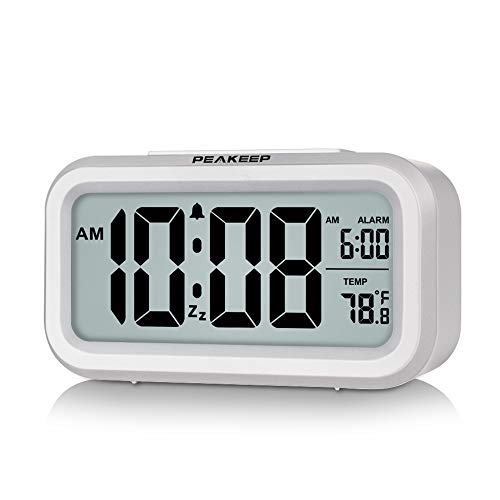
The MH-9060 is the pick when you want the clock to double as a night light and a thermometer, and you want a stated warranty in writing.
Best for: readers who want a night light, temperature and a written warranty Skip it if: you want the smallest, lightest option in this set
This is the only pick with a published warranty: 90 days from the date of purchase, according to the listing. It is also the only pick with a built-in night light (three dimmers: low, high, off) and an indoor temperature monitor spanning 15.8 to 122 Fahrenheit with a stated tolerance of plus or minus 1 degree. The progressive alarm ramps for 90 seconds. Dimensions come in at 3.94 x 3.94 x 1.5 in and 6.56 oz, running on 3 AAA cells.
The cost is weight and bulk. At 6.56 oz, it's more than double the Sharp, and the square footprint takes more nightstand than the slim Peakeep sibling. There is also a second seller listed here, the only pick where that is true, so stock and shipping vary by choice. Against the Sharp, you gain a night light, a thermometer and a warranty. Against the MHP6020, you gain the night light and temperature but lose the lock function and the five volume levels.
Pros:
- Adjustable night light with three settings
- Indoor temperature gauge with stated tolerance
- 90-day manufacturer warranty listed
- Progressive alarm runs 90 seconds
- Two sellers listed for buying flexibility
Cons:
- Heaviest pick in the set at 6.56 oz
- Bulkier square footprint
- AAA cells drain faster than AA
- No lock function against accidental button presses
Is a portable clock really travel-ready?
Not automatically. Amazon's search treated "portable" and "battery operated bedside" as the same thing, so the results mix true travel clocks with small nightstand clocks. Judge each pick against your bag before you buy.
Two figures tell you what you need. Weight and the smallest dimension. The Peakeep MHP6020 at 1 x 5.4 x 1.5 in is the only pick that is genuinely thin enough to slide alongside a paperback. The Sharp at 4 x 2.3 x 1.5 in is small in every direction but still a cube rather than a wafer. The MH-9060 at 6.56 oz is comfortably nightstand-sized but pushes the top of what I'd call carry-on friendly for a single-purpose device.
A second thing that catches travellers out: none of the five ships with batteries. Buy a pack before a trip, or you'll arrive with a dark clock and no shop open. The MHP6020's format lock is also worth having on the road, because bag pressure will set an alarm for 3.14 a.m. otherwise.
Features worth paying for, and features that waste money
The features that earn their place, based on what the listings publish:
- Auto dimming, so you don't wake to a searchlight. Acedeck, Srubambi and the Peakeep MHP6020 all list it.
- Lock function, so a jostled bag doesn't reset the alarm. Only the Peakeep MHP6020 lists one.
- Published digit size, so you know the number is big enough to read without glasses. Only Acedeck publishes a figure (1.8 in).
- Multiple volume levels, so a light sleeper isn't shouted at and a heavy sleeper isn't whispered to. Only the Peakeep MHP6020 lists five.
Features I'd think twice about paying more for in this category:
- Ascending or progressive beeps are common (Sharp and MH-9060 list them). They're welcome, not a differentiator.
- A thermometer is a nice-to-have on the MH-9060 but not a reason to skip a slimmer pick.
- A night light matters if you have kids or navigate the room at night. If not, it just draws current.
Notice what's missing across the board. No listing publishes a battery life figure, which is the one number you'd actually want. Plan on a fresh pack of cells every six to twelve months and you won't be surprised.
Quick if/then guide for the indecisive
If you're stuck between two picks, run through this. Each threshold is checkable against a spec you can see on the listing.
- If the clock never leaves your nightstand and you want always-on visibility, go Acedeck T01 for the published 1.8-inch digits.
- If it does leave your nightstand for trips more than twice a year, go Peakeep MHP6020 for the 1-inch profile and the lock.
- If you want the simplest, lightest clock and don't mind pressing a button to read the time, go Sharp SPC483CAMZ at 3.21 oz.
- If a night light and a room thermometer would earn their space, go Peakeep MH-9060 for the 90-day warranty and the temperature gauge.
- If your room is tight on surface area and you want a quiet, always-visible display, go Srubambi T02-1 at 2.32 x 4.88 in.
Two picks share a brand, which confuses some shoppers. The MHP6020 is the slim travel-first Peakeep. The MH-9060 is the feature-heavy nightstand Peakeep. They aren't versions of each other; they're different designs at different price positions.
The verdict
At the entry tier, the Sharp SPC483CAMZ is the right default portable digital alarm clock. It's the lightest and most compact pick here at 3.21 oz and 4 x 2.3 x 1.5 in, and it does the basic job with an ascending alarm, a top-mounted snooze, and an on-demand backlight. Buy it if you value pocketability and don't need the display lit all night.
In the middle tier, the Acedeck T01 is the pick for a permanent nightstand. The 1.8-inch red LEDs are the only published digit size in the set, and the auto dimming plus dual AA and Type-C power make it the most flexible clock here. It's larger and heavier at 4.8 oz, and that's the cost of the bigger, always-on number.
At the premium tier, two clocks split the job. The Peakeep MH-9060 adds a night light, an indoor thermometer, and the only stated warranty in the set (90 days). The Srubambi T02-1 keeps a slim white-digit display running around the clock in a smaller footprint. Choose by whether the extra features earn their nightstand space.
FAQ
Is a battery-operated clock actually reliable overnight?
Battery-operated clocks are reliable overnight when you use fresh alkaline cells and change them on a schedule. None of the five listings publish a battery-life figure, so plan on a fresh pack every six to twelve months. The Acedeck also accepts Type-C power if you want a backup, and the Peakeep MHP6020's lock function prevents accidental resets that would ruin the alarm silently.
How loud does the alarm actually need to be?
How loud the alarm needs to be depends on your sleep depth and how far the clock sits from your head. Only the Peakeep MHP6020 publishes five volume levels, so it's the safest pick for heavy sleepers. The Sharp and the Peakeep MH-9060 list ascending or progressive beeps that start soft and build. Srubambi and Acedeck don't publish volume detail, so light sleepers should prefer them.
Sharp SPC483CAMZ or Acedeck T01, which should I buy?
Sharp SPC483CAMZ or Acedeck T01 comes down to whether you want the display lit all the time. The Sharp is the lighter clock at 3.21 oz with a button-triggered blue backlight and no always-on display. The Acedeck T01 is 4.8 oz with 1.8-inch red LEDs on continuously and auto dimming. Pick the Sharp for portability, the Acedeck for a permanent bedside spot.
Are AAA batteries a real problem versus AA?
AAA batteries are a real trade-off, not a deal-breaker. AA cells hold more energy at the same drain, so a clock like the Acedeck T01 with 4 AA cells will typically outlast the Peakeep MHP6020 or MH-9060 on 3 or 4 AAA cells. If you'd rather change batteries once a year instead of twice, and pack size doesn't rule, favour AA-powered picks.
What's the biggest mistake buyers make in this category?
The biggest mistake buyers make is buying on alarm features and ignoring the display. You look at the clock a hundred times before it wakes you once, so digit size, always-on visibility and auto dimming matter more than a fancy beep pattern. Only Acedeck publishes a digit size (1.8 in), and three of the five picks list auto dimming, which is the single most useful bedside feature here.
The right portable digital alarm clock is the one you'll actually stop reaching for the phone to check. If you're setting up a new nightstand this week, start with the Sharp SPC483CAMZ: it's the smallest, lightest pick, it needs no outlet, and the top-mounted snooze means you set it once and forget it. If your room already has a spot on the shelf and you'd rather never press a button to read the time, the Acedeck T01 with its 1.8-inch always-on digits is the better long-term buy. Either way, put a pack of the right batteries in the drawer before the clock arrives.