Best Area Rug for Basements When Space Is Tight

Seven washable and low-pile rugs compared for basement floors, from the FinRèc Home 5x7 winner to a 25 lb polypropylene pick built for heavy foot traffic.

By Cody HartUpdated 15 min read
On this page
- How I screened these seven rugs
- Best area rug for basements at a glance
- Does any rug here handle basement moisture?
- Pile height is the spec that actually decides it
- 1. FinRèc Home 5x7 — Best overall
- 2. Lbris 8x10 — Best for beginners
- 3. Miukiki 8x10 — Best lightweight
- 4. AMADA HOMEFURNISHING 9'x12' — Most versatile
- 5. Garland Rug Sparta 8x10 — Best for families
- 6. Recmalk 8x10 — Best for heavy use
- 7. Rugshop Bohemian — Best premium
- What size fits a basement floor?
- When a different rug wins
- The verdict
- FAQ
The best area rug for basements is the FinRèc Home 5x7, a washable low-pile rug at 0.24 in thick that lies flat and stays put on hard floors. Go with the AMADA HOMEFURNISHING 9'x12' instead if your basement is large and open, since it covers 108 square feet in one piece. Most buyers compare colour and softness first. In a basement, thickness and cleanability decide it.
How I screened these seven rugs
Here's the misconception worth clearing up. Shoppers pick a basement rug the way they pick a living room rug, by colour and how plush it looks in the photo. A basement is a different floor. It sits on concrete or slab, it collects dust and the occasional spill, and it rarely has the airflow a main floor gets. That changes what matters.
None of these seven listings names a waterproof or moisture-barrier backing. That is worth saying up front, because Amazon's search for a basement rug returns general area rugs, not sealed ones. I judged each pick on the traits that survive a basement instead: a thin profile that lies flat, a non-slip backing, and machine washability.
I lined up the published specifications side by side and cut on three points:
- Pile height. Thin wins in a basement. Four picks sit at 0.24 in.
- Backing. Every rug here claims a non-slip layer, so I looked at what it grips.
- Cleaning. Five are machine washable; two are spot-clean only.
The best area rug for basements is not the softest one. It is the one you can lift, wash, and set back down without a fight. That framing shaped the whole list.
Best area rug for basements at a glance
| Pick | Pile height | Washable? | Price |
|---|---|---|---|
Best overall FinRèc Home 5x7 |
0.24 in | Machine washable | Check Price |
Best for beginners Lbris 8x10 |
0.3 in | Machine washable | Check Price |
Best lightweight Miukiki 8x10 |
0.24 in | Machine washable | Check Price |
Most versatile AMADA 9'x12' |
0.24 in | Machine washable | Check Price |
Best for families Garland Sparta 8x10 |
0.6 in | Spot clean | Check Price |
Best for heavy use Recmalk 8x10 |
0.4 in | Machine washable | Check Price |
Best premium Rugshop Bohemian |
0.39 in | Spot clean | Check Price |


Does any rug here handle basement moisture?
Short answer: none of these seven listings claims a moisture barrier. That matters, so let me be plain about it. A basement floor can get damp, and no rug in this set is described as waterproof, sealed, or vapour-blocking. Amazon returned general area rugs for the search, and the modifier did not filter for basement-specific construction.
So what do you do? You lean on the traits that reduce trouble instead:
- A thin pile dries faster and traps less than a plush one. The 0.24 in picks win here.
- A washable rug lets you clean it fully if something spills or the floor sweats.
- A synthetic fibre resists absorbing water. Several here use polyester or polypropylene per their listings.
If your basement has a known damp problem, put a separate moisture pad or barrier under any rug you buy. That is a decision you make about your floor, not something these products solve. The best area rug for basements in a dry, finished space is a different call from one in a slab basement that weeps in spring. Judge your own floor first.
Pile height is the spec that actually decides it
Pile height is the number I kept coming back to. In a basement, a thin rug lies flatter against an uneven slab, dries quicker, and slides under a door without catching. A thick, plush rug feels great in a bedroom and fights you everywhere else.
Here is how the seven stack up by published pile:
- 0.24 in: FinRèc Home, Miukiki, AMADA
- 0.3 in: Lbris
- 0.39 in: Rugshop Bohemian
- 0.4 in: Recmalk
- 0.6 in: Garland Sparta
The gap between 0.24 in and 0.6 in is real. That's a difference of 0.36 in, which is the space a door needs to clear. Pile height is the spec that separates a rug you set down once from one you trim doors around. For most basements, I'd start at the thin end and only go thicker if you specifically want cushion underfoot.
1. FinRèc Home 5x7 — Best overall
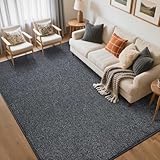
The FinRèc Home 5x7 is the best area rug for basements because it pairs a 0.24 in low pile with machine washability and a TPR non-slip back, the exact combination a basement floor rewards.
Best for: a small finished basement where you want a washable, thin rug that lies flat Skip it if: your floor is bigger than 5 by 7 feet
What sets this pick apart is that it does the basement job without excess. At 0.24 in thick and 5' x 7', it sits flat on a slab and moves under a door without dragging. FinRèc says the TPR backing keeps the rug in place, protects the floor, and cuts noise, which is useful on echoey concrete. It is the cheapest of the seven, and it also sells faster than most of this set.
The care note is honest: FinRèc says the rug ships vacuum-compressed and may need two to four days flat to regain loft and shed any odour. That is normal for a rolled rug. It is machine washable cold, so a basement spill is not a crisis.
The trade-off is size. At 5' x 7', it is the smallest rug here by a wide margin, so it suits a reading nook or a landing rather than a full open basement. For a bigger floor you would size up to one of the 8x10 picks and lose the low price.
Pros:
- Thinnest pile in the set at 0.24 in
- Machine washable cold for easy cleaning
- TPR non-slip backing grips hard floors
- The cheapest of the seven
Cons:
- Smallest size at 5' x 7'
- Ships compressed, needs days to flatten
- No published weight or warranty
2. Lbris 8x10 — Best for beginners
The Lbris 8x10 is the easiest first basement rug: a big, washable, multi-colour piece at 0.3 in that hides dust and forgives mistakes.

Best for: a first-time buyer covering a mid-size basement on a low budget Skip it if: you need a firmer, heavier rug that stays put under traffic
If you have never bought a rug for a basement, this is the low-risk start. It covers 8' x 10', it is the second-cheapest here, and Lbris says it is machine washable. The blue-griege-brown-beige-white colourway is busy on purpose, and that busyness hides the fine dust a basement throws off between cleans.
Lbris lists it at 10 lb and 0.3 in thick, so it is light enough to handle but still thin enough to lie reasonably flat. The listing describes soft faux wool over recycled polyester with hand-wrapped edges, plus a TPR non-slip back. Those are the maker's claims, not measured facts, but they line up with a beginner-friendly build.
The trade-off is firmness. At 10 lb across 80 square feet, this is a light rug, and a light rug can creep under heavy foot traffic more than a dense one. For a low-traffic den it is fine. For a busy playroom, the heavier picks hold better.
Pros:
- Large 8' x 10' coverage
- Machine washable per the listing
- Busy colourway hides dust
- Second-cheapest in this set
Cons:
- Light at 10 lb, can shift under traffic
- Faux wool softness is a maker claim
- No warranty listed
3. Miukiki 8x10 — Best lightweight
The Miukiki 8x10 is the one you can lift and wash alone, at just 9 lb with a thin 0.24 in pile.

Best for: anyone who wants to lift and wash the rug alone Skip it if: you want a plush, thick underfoot feel
Weight is the story here. At 9 lb, the Miukiki is the lightest 8x10 in this group, which matters more in a basement than it sounds. You often have to carry a rug up a flight of stairs to wash it or shake it out. Nine pounds you can do solo. Twenty-five pounds you cannot.
It shares the 0.24 in low pile of the winner, so it lies flat and clears doors. Miukiki describes a Moroccan-style geometric pattern in grey, a non-slip TPR backing, and a shed-resistant surface that only needs regular vacuuming. The listing also flags shipping creases that settle within a few days, which is standard.
The trade-off is feel. A 9 lb, 0.24 in rug is thin and firm, not the cushioned kind you sink into. If you want plush underfoot in a basement lounge, the Recmalk or Garland gives you more body. For sheer ease of handling and cleaning, nothing here beats this one.
Pros:
- Lightest 8x10 at 9 lb
- Thin 0.24 in pile lies flat
- Machine washable per the listing
- Shed-resistant grey pattern
Cons:
- Thin build means little cushion
- Softness and shed claims are the maker's
- No warranty listed
4. AMADA HOMEFURNISHING 9'x12' — Most versatile
The AMADA 9'x12' is the pick that fills a large basement in one piece, covering 108 square feet at a thin 0.24 in.

Best for: a large open basement that needs one rug to fill it Skip it if: your space is under 100 square feet
Size is what earns this its spot. At 9' x 12', it is the biggest rug in the set and covers 108 square feet, enough to anchor a whole open basement without seams or a second rug. Yet AMADA keeps the pile at 0.24 in, so despite the footprint it still lies flat on a slab. That mix of large and thin is rare, and it is why this one flexes across so many layouts.
It weighs 26.8 lb, the second-heaviest here, which is the price of covering that much floor. AMADA describes soft faux wool fibres, double-stitched edges, and a non-slip TPR backing that grips tile or wood. The dark blue abstract pattern reads modern and hides marks well.
The trade-off is handling and fit. At nearly 27 lb it is a two-person job to wash or move, and in a small basement a 9'x12' will overwhelm the room. It is the middle of the pack on price. Buy it only if your floor genuinely needs the reach.
Pros:
- Largest coverage at 108 square feet
- Still thin at 0.24 in pile
- Double-stitched edges per the listing
- Dark colour hides marks
Cons:
- Heavy at 26.8 lb to wash or move
- Too large for small basements
- Faux wool feel is a maker claim
5. Garland Rug Sparta 8x10 — Best for families
The Garland Sparta 8x10 is the toughest pick for a family basement: 25 lb of stain-resistant polypropylene built for high traffic.

Best for: a playroom or high-traffic basement with kids and spills Skip it if: you want a soft, washable rug you can toss in the machine
This is the workhorse. At 25 lb across 80 square feet, the Garland is the heaviest rug here, and that density means it stays planted under running kids and dragged furniture. It is made of 100% polypropylene, which Garland describes as stain resistant and made in the USA. Black hides scuffs, and the geometric pattern suits a rec room.
Two sellers list it, the only rug in this group with more than one, and the listing states plainly there is no warranty. That honesty is worth noting. Garland leans on the material rather than a guarantee.
The trade-off is cleaning and comfort. This is a spot-clean rug, not machine washable, so a big spill means scrubbing on the floor rather than a wash cycle. At 0.6 in it is also the thickest here, so it will catch on a low door and needs the clearance. For a durable, planted family surface it delivers. For quick washing, look to the thin picks above.
Pros:
- Heaviest and most planted at 25 lb
- Stain-resistant polypropylene per the listing
- Black hides scuffs and marks
- Made in the USA
Cons:
- Spot clean only, not machine washable
- Thickest pile at 0.6 in catches doors
- No warranty, per the listing
6. Recmalk 8x10 — Best for heavy use
The Recmalk 8x10 pairs a plush high-low pile with machine washability, a rare mix for a basement that gets constant traffic.

Best for: a basement that gets constant foot traffic and needs cushion Skip it if: you move furniture often and dislike heavy rugs
The Recmalk splits the difference between plush and practical. It runs 0.4 in with a high-low pile Recmalk describes as thick and cushioned, so it feels warmer underfoot than the thin picks, and yet the listing says it is fully machine washable. That combination is unusual. Most cushioned rugs here are spot-clean only.
Its own listing calls out basements by name as a space it suits, which is more than any other pick offers. It weighs 16 lb in light beige, a neutral that works in most finished basements. Recmalk says the non-slip backing keeps it in place on hard floors.
The trade-off is price and colour upkeep. It sits at the top of the range here, the most expensive of the seven, and it moves the slowest of this set. Light beige also shows dirt faster than the darker rugs, which cuts against a busy basement. If you want cushion and washability together and don't mind the price, it earns the spot. Otherwise the thin picks cost less and clean just as easily.
Pros:
- Cushioned 0.4 in high-low pile
- Machine washable despite the plush build
- Listing names basements specifically
- Neutral light beige colour
Cons:
- Most expensive of the seven
- Light beige shows dirt
- Slowest seller in this set
7. Rugshop Bohemian — Best premium
The Rugshop Bohemian is the style pick, a jute-backed polypropylene rug with a striped bohemian look for a basement lounge.

Best for: a styled basement lounge where the look matters most Skip it if: you want a machine-washable rug
This is the one you choose for the room's look. The Rugshop measures 7'10" x 10' in a black bohemian stripe, and its 100% polypropylene pile at 0.39 in is built, per the listing, for high-traffic areas. Rugshop describes it as kid and pet friendly and durable against everyday wear. It reads more designed than the plain solids in this group.
Here is the catch a buyer needs to see. The care instructions say spot clean with mild detergent or clean professionally, and the listing recommends a separate rug pad. So it is not a wash-and-drop rug, and it uses a jute backing rather than the TPR non-slip layer the washable picks carry.
That makes it the least basement-friendly on cleaning, even though the style is the best here. It sits in the upper price range with no published warranty, and only one seller lists it. If your basement is a finished lounge and looks lead the decision, it fits. For a functional, washable floor, the thin picks above serve better.
Pros:
- Distinct bohemian striped look
- Durable polypropylene pile per the listing
- 0.39 in pile for high-traffic areas
- Jute backing for a natural feel
Cons:
- Spot clean only, not machine washable
- Needs a separate rug pad
- Upper price range with no warranty
What size fits a basement floor?
Size trips up more basement buyers than any other spec, so match the rug to the zone you are covering, not the whole slab. A basement rug usually defines a seating or play area, and you want a foot of bare floor showing around it.
Here is a quick map of the sizes in this set:
- 5' x 7' (FinRèc): a nook, a landing, a single chair zone
- 8' x 10' (Lbris, Miukiki, Recmalk, Garland): a standard seating or play area
- 7'10" x 10' (Rugshop): effectively an 8x10 for the same use
- 9' x 12' (AMADA): a large open basement, filled in one piece
Measure your floor before you buy. A 9'x12' in a small basement swallows the room, and a 5x7 in a big one looks lost. The best area rug for basements is the one sized to your zone, not the biggest one you can find.
When a different rug wins
The FinRèc leads for most people, but three clear conditions flip the pick. Each is checkable against your own basement.
- Your floor is large and open. If you are covering more than 100 square feet in one piece, the AMADA 9'x12' is the better buy at 108 square feet and a thin 0.24 in pile.
- Kids and heavy traffic rule the space. For a playroom that takes a beating, the 25 lb Garland Sparta stays planted and resists stains, at the cost of machine washing.
- You want cushion and washing. The Recmalk pairs a 0.4 in plush pile with machine washability, the only pick here that does both, if you accept the higher price.
The cutoff is roughly this: at or under 80 square feet with a priority on easy washing, go thin and cheap. Above 100 square feet or under constant traffic, size up or go heavier. That threshold, plus your floor's dampness, settles nearly every case.
The verdict
The best area rug for basements is the FinRèc Home 5x7. If you have a small, finished, mostly dry basement and want a rug that lies dead flat, grips the floor, and washes clean, it does all three at the lowest price in this group. At 0.24 in thick with a TPR non-slip back, it fits the basement job better than anything else here for the money.
The split is by floor size. If your basement is small or you are defining one zone, the FinRèc wins outright. If your basement is large and open, the AMADA 9'x12' takes it: same thin 0.24 in pile, but 108 square feet of coverage in one piece so you skip the seams and second rugs. The cutoff sits around 100 square feet. Below it, the FinRèc; above it, the AMADA.
One honest caveat carries across all seven. None of these listings claims a moisture barrier, so if your basement gets damp, add a separate pad and pick a thin, washable synthetic you can clean often. That is the trait that actually protects a basement floor, and it is what put the thin, washable picks at the top of this list.
FAQ
Is an area rug worth it in a basement?
An area rug is worth it in a basement when the floor is finished and mostly dry. It adds warmth over cold concrete, cuts echo, and defines a seating or play zone. Choose a thin, washable synthetic like the 0.24 in FinRèc so you can clean it often. In a damp basement, add a separate moisture pad underneath first.
What is the best area rug for basements on a budget?
The best area rug for basements on a budget is the FinRèc Home 5x7, the cheapest of the seven here. It gives you a 0.24 in low pile, a TPR non-slip backing, and machine washability, the three traits a basement floor rewards, without the size or cushion premium the larger and plusher picks add.
What size rug fits a basement floor?
The size rug that fits a basement floor depends on your zone, not the whole slab. A 5' x 7' suits a nook or single chair, an 8' x 10' covers a standard seating area, and a 9' x 12' fills a large open basement. Leave about a foot of bare floor showing around the rug.
Should I choose the FinRèc or the AMADA for my basement?
Choose the FinRèc for a small or single-zone basement, since its 5' x 7' size and lowest price fit tight finished spaces. Choose the AMADA 9'x12' for a large open basement, since it covers 108 square feet in one piece. Both share a thin 0.24 in pile, so the decision is purely floor size.
What basement rug mistake should I avoid?
The basement rug mistake to avoid is assuming any of these is waterproof. None of the seven listings claims a moisture barrier, so a damp slab can still cause trouble underneath. Pick a thin, washable synthetic, add a separate moisture pad if your floor sweats, and clean the rug regularly rather than trusting it to handle water alone.
Measure your basement zone, check whether the floor stays dry, then decide on size. For most finished basements, the FinRèc Home 5x7 is the right default: it is thin enough to lie flat on concrete, washable when a spill happens, and it grips the floor without a separate pad. Size up to the AMADA 9'x12' only if you are filling a large open room. Whichever you choose, add a moisture pad if your slab ever feels damp, and you will get years of clean, quiet, warmer footing out of a floor that usually offers none.